
A Cultural Reflection from an American Traveler in Korea

Travel teaches you many things — the food, the landscape, the history.
But sometimes the thing that leaves the deepest mark is how people make you feel.
During my time in South Korea, I experienced a kind of kindness that felt different from anything I had known. Not politeness. Not customer service. Something deeper — something woven into daily life.
There’s a word for it:
정 (Jeong)
Pronounced “jung.”
Jeong is a uniquely Korean concept with no exact English equivalent.
It is often described as:
A deep emotional bond formed through shared time
Care expressed through actions, not words
Generosity without expectation of repayment
A warmth that says, “You belong here.”
In Korea, kindness isn’t transactional — it’s relational.
🌸 What Jeong Looks Like
Jeong appears quietly, almost invisibly, through small, thoughtful gestures:
Someone walking with you instead of merely giving directions
A person insisting on treating you to coffee — “Today, I take care of you.”
A neighbor dropping off soup when you’re sick, without announcing it
People helping simply because you’re connected
There’s no scorekeeping.
No awkwardness around giving or receiving.
The care itself is the relationship.
🇰🇷 Why It Feels So Moving
Coming from American culture — a culture built around independence, splitting checks, and not wanting to impose — this level of connection can feel almost unbelievable at first.
In the U.S., we often say:
“I don’t want to trouble you.”
In Korea, someone might respond:
“It’s no trouble. We’re connected.”
Where we try not to burden others, Koreans show care by getting involved.
🌍 Jeong Isn’t Limited to One Country
Although jeong is a uniquely Korean cultural concept, I’ve learned that genuine care isn’t limited to a nationality or a place.
I have friends in the United States who have shown up for me without hesitation — people who stepped in when things were physically or emotionally difficult, and cared simply because they cared. On my recent trip, the friends I traveled with demonstrated that same spirit of presence and support.

Their actions reminded me that kindness and interdependence aren’t “Korean” or “American” traits —
they are human behaviors.
Korea simply gave me a name for it.
Jeong helped me recognize something I’ve felt before, even at home:. real friendship shows up.
💕 What Jeong Does to You
Jeong does something subtle but powerful:
It makes you want to become that kind of person.
You start wanting to:
Show up fully
Give without keeping score
Create a sense of belonging wherever you go
You carry the warmth home with you.
🌱 The Lasting Impact
Jeong teaches that care isn’t about obligation — it’s about presence.
It’s about saying, through actions rather than words:
“You matter.”
And that kind of connection stays with you long after the trip ends.
✨ What I Learned
I traveled to Korea curious about culture.
I came home inspired to cultivate connection.
To stop apologizing for needing people.
To stop keeping score.
To build relationships where generosity flows naturally.
Because the world needs more jeong — everywhere.
🌱 How to Practice Jeong in Everyday Life
While jeong is deeply rooted in Korean culture, its spirit can be practiced anywhere.
You don’t need to speak Korean or travel overseas — just show up with sincerity.
1. Give without keeping score
Pay for the coffee — don’t mention “next time.”
Offer help because you care, not because it’s reciprocated.
Jeong says: I’m giving because you matter — not because you owe me.
2. Show up physically
Bring food when someone is sick.
Sit beside someone during a hard moment.
Accompany, rather than instruct.
In Korea, people don’t point to the location — they walk you there.
3. Notice the little needs
Save someone a seat.
Remember their coffee order.
Carry something heavy without being asked.
Care lives in details.
4. Be consistent over time
Check in because you were thinking of them.
Celebrate their wins without jealousy.
Be loyal in the ordinary moments.
Consistency builds emotional safety.
5. Accept kindness — not just give it
Receiving without guilt builds connection.
Instead of: “No, you don’t have to.”
Try: “Thank you. That means a lot.”
Jeong is a two-way bridge.
6. Include people
Invite someone to join you.
Add an extra chair at the table.
Create space, not exclusivity.
Connection grows when people are welcomed in.
7. Care with actions, not declarations
You don’t need big speeches. Just do the thing.
In jeong, the gesture is the message.

✨ Practicing Jeong Creates Connection
When we give without expectation,
show up without hesitation,
and care without condition…
We create spaces where people feel seen, safe, and valued.
And that — more than food, travel, or scenery —
is the part of Korea that stays with you.
The most beautiful souvenir from any journey is the people who touched your heart.
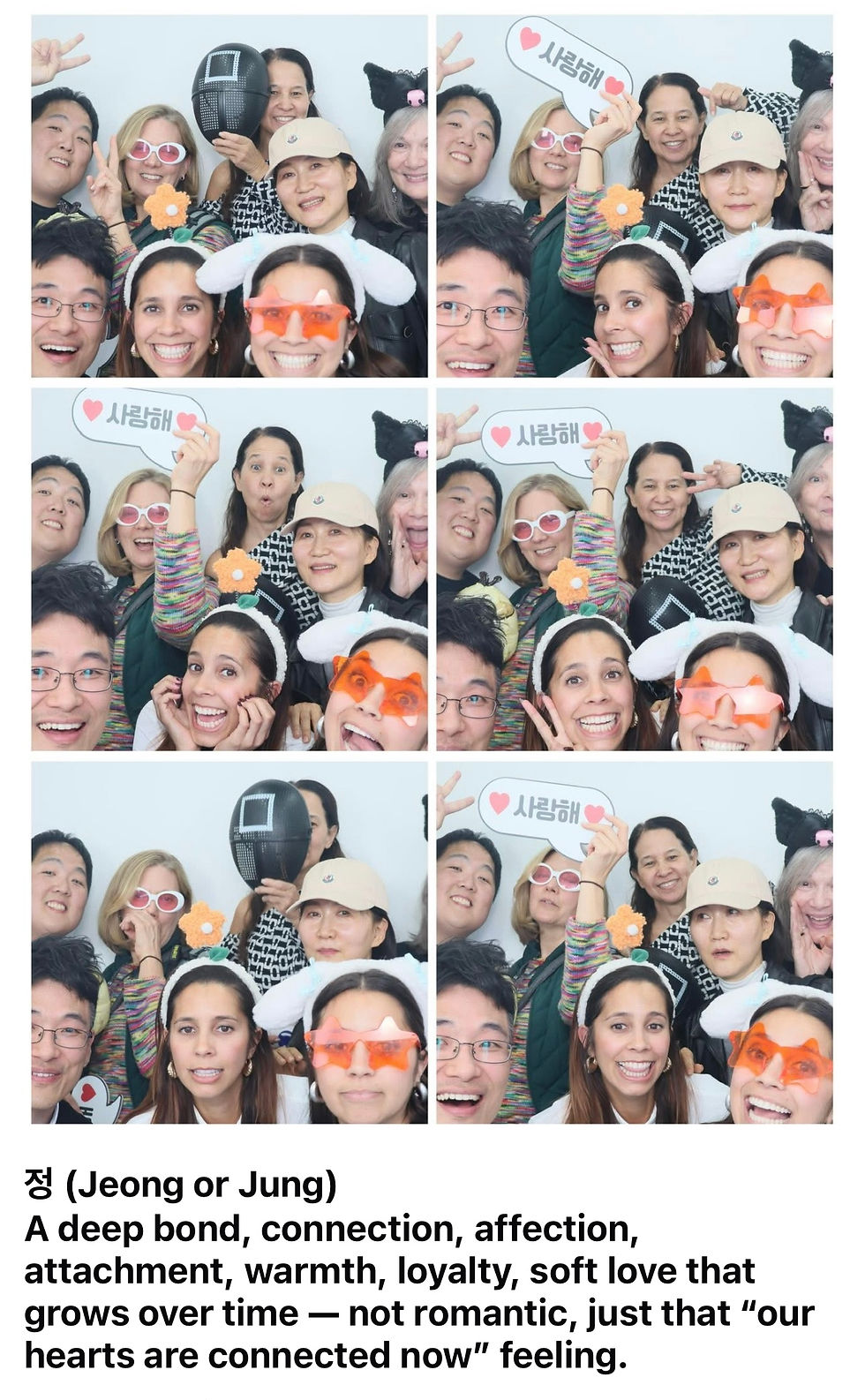


We truly are connected. Wonderful reminder.
Beautiful!